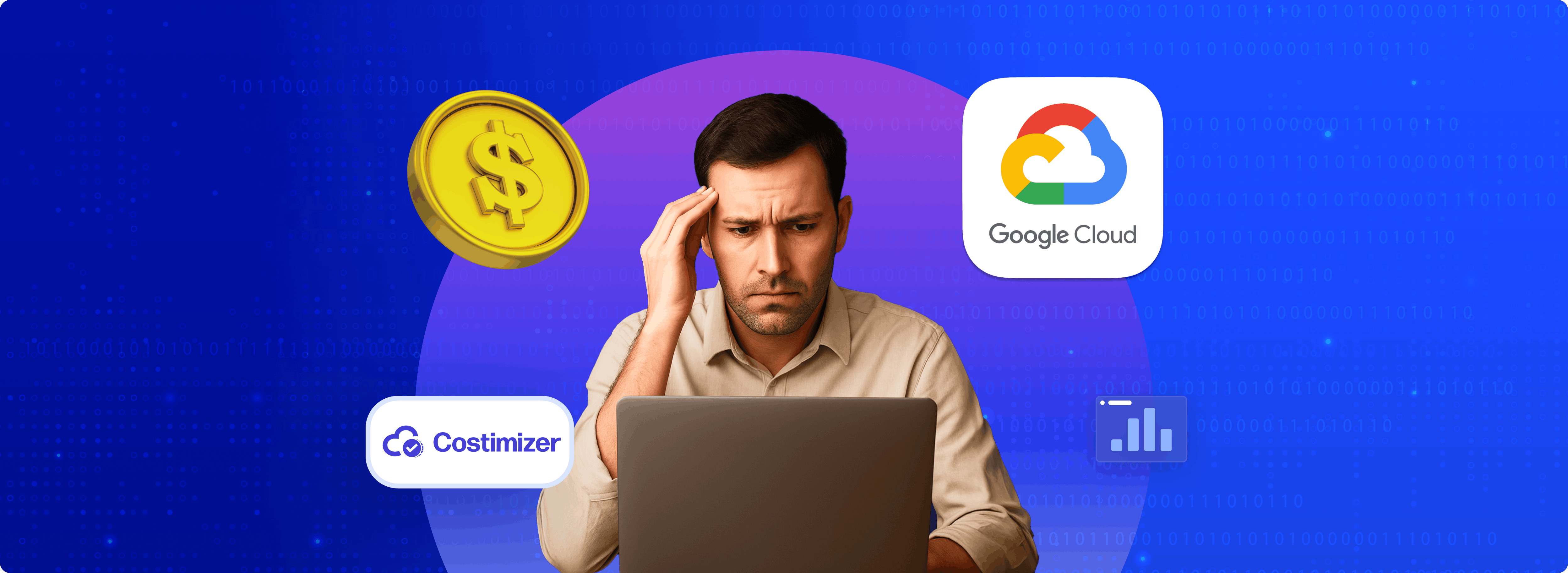


A developer recently shared a terrifying reality on a public forum: they ran 17 test queries on a public dataset in Google Cloud Platform (GCP). Ten days later, they received a bill for $58,940.
This is a common reality for companies operating in the cloud today. The cloud gives every engineer a corporate credit card. A single typing error or a forgotten test environment can drain your operating budget overnight.A single typing error or a forgotten test environment can drain your operating budget overnight, highlighting the need for specialized GCP cost management strategies.
You cannot wait for the end-of-month invoice to find out you overspent. You need immediate alerts.
This blog explains how to identify unexpected billing spikes using Google Cloud cost anomaly detection, how to build custom alert systems, and how to protect your profit margins from uncontrolled cloud spending.
Key Takeaway:
What anomaly detection actually does: It catches unexpected cost spikes instantly.
Why it’s critical: Reduces detection time from approx monthly to a few hours, preventing waste and catching issues like cryptojacking early.
Common causes of bill shock: Traffic spikes, forgotten test servers, and bad queries/logging can pile up huge costs.
How GCP native tool works: Uses ML to detect anomalies, shows root cause (service/project/region), and sends alerts via email or Pub/Sub.
Limitations & better approach: Native tools are delayed and reactive; advanced teams use BigQuery and ML or FinOps tools for real-time, multi-cloud visibility and automation.
An anomaly is a sudden, unexpected deviation from your historical spending patterns. It is a billing spike that the system did not predict.
Many business owners confuse different financial terms. You must understand the distinct functions of these three financial controls:
Unexpected charges rarely come from legitimate business growth. They usually stem from operational errors.
Traffic Spikes: A sudden influx of users can automatically scale up your resources. While user growth is positive, unoptimized auto-scaling can consume massive amounts of compute power and data transfer fees.
Orphaned Test Environments: Engineers frequently create temporary servers for testing. If they forget to turn them off, these "zombie resources" run 24/7. You pay for them continuously.
Configuration Errors: A minor coding error can cause a system to generate millions of unnecessary log files per hour. Similarly, poorly written database queries scan the entire database instead of a specific section, resulting in massive charges.
GCP billing anomaly detection is a mandatory requirement for financial survival, not a nice-to-have. Relying solely on monthly invoices is a failed strategy.
The primary goal is to reduce your Mean Time to Detect (MTTD) and Mean Time to Resolve (MTTR). Without anomaly detection, your MTTD is 30 days, and you discover the waste when the bill arrives. With real-time GCP cost anomaly detection, your MTTD drops to a few hours. Finding and fixing a problem on day one saves you 29 days of wasted capital.
Billing spikes are often the first indicator of a security breach. If a bad actor gains access to your GCP account, their first action is usually deploying servers to mine cryptocurrency. This is called cryptojacking. A sudden, massive spike in Compute Engine costs is a red flag. Anomaly detection serves as an early warning system for compromised credentials.
Finance teams care about budgets. Engineers care about building products. Anomaly detection creates a shared language. When an alert triggers, the finance team sees the financial impact, while the engineering team receives the exact project and service details needed for Root Cause Analysis (RCA). This stops internal arguments and focuses the company on fixing the problem.
Google provides a native, free tool within the Cloud Billing console. This tool continuously monitors your usage. Previously, anomaly detection models required six months of historical data to function accurately. Google recently updated the system. New projects are now protected from day one, as the algorithm adapts much faster to new spending patterns.
The native tool operates through three main components:
If you turn on every alert, your engineers will experience alert fatigue. They will start ignoring the notifications. You must properly configure the tool to ensure that only severe issues trigger alarms.
IAM Permissions You cannot view or manage anomalies without the correct Identity and Access Management (IAM) roles. You need the Billing Account Administrator (roles/billing.admin) role to change threshold settings and submit feedback. Users with the Billing Account Viewer role can see the anomalies, but cannot alter the configurations.
Managing Thresholds You filter out false positives by adjusting two specific thresholds: Cost Impact and Percentage Deviation.
Cost Impact is an absolute dollar amount. You can set the system to ignore any anomaly that costs less than $100. Percentage Deviation tracks relative changes. You might set the alert to trigger only if the spend is 50% higher than the expected baseline. Using both settings together ensures you only receive alerts for mathematically significant and financially painful events.
Setting Up Notifications You can configure the system to send Google Cloud billing anomaly detection alerts as simple emails to your billing administrators. However, modern teams require faster communication. You can connect the anomaly detector to Google Cloud Pub/Sub.
Pub/Sub is a messaging service that routes the alert data to external tools. Google Cloud cost anomaly detection with Pub/Sub lets you send automated notifications directly into a dedicated Slack channel or create an incident in PagerDuty.
The Feedback Loop Machine learning models require training. When you review an anomaly in the GCP console, you can submit feedback. You can mark the spike as "Expected" (e.g., you launched a new product) or "Unexpected" (a genuine error).
This feedback trains the model, reducing future false alarms and improving the system's accuracy for your specific business.
The native GCP tool is effective for basic monitoring. However, large enterprises with complex internal structures often outgrow it. You might need custom logic to track specific departments, enforce distinct rules for different applications, or analyze precise SKU-level data.
n these cases, you must build a custom GCP cost analysis tool- often as part of a broader BigQuery cost optimization strategy, using BigQuery and Cloud Monitoring.
You must route your raw billing data into a data warehouse for analysis. In the GCP Console, navigate to Billing Export and enable "Detailed usage cost data" to export directly to a BigQuery dataset. You must select a multi-region location to ensure you receive retroactive data backfills.
You must account for data lag. Google Cloud billing data can take a few hours to appear in BigQuery. Your custom queries must account for the difference between the usage date (when the computation happened) and the export date (when the data arrived in the table).
You do not need to export the data to a third-party machine learning tool. You can use BigQuery ML (BQML) to run predictive models directly inside your data warehouse.
You should use the ARIMA_PLUS model. This specific model excels at time-series forecasting. It automatically accounts for seasonality (e.g., higher traffic on weekdays than weekends) and holiday trends.
Pro-Tip: While anomaly detection catches spikes, baseline savings come from architectural choices. Ensure you are maximizing Sustained Use Discounts for predictable workloads and leveraging Committed use discounts for long-term capacity planning.
You cannot run this SQL query manually every day. You must set up a Scheduled Query in BigQuery to run the anomaly detection function every morning. If the query detects an anomaly, you can push a custom metric to Google Cloud Monitoring. From there, you create an Alerting Policy to send an email, Slack message, or SMS to the responsible engineering team.
Most enterprises do not use a single cloud provider. They operate in a multi-cloud environment. You must understand how GCP's native tools compare to its competitors.
AWS Cost Explorer: AWS offers Cost Anomaly Detection within its Cost Explorer suite. It uses Cost Monitors to track spending by AWS service or member accounts. It integrates deeply with Amazon EventBridge, allowing users to trigger automated serverless functions (AWS Lambda) when a cost spike occurs.
Azure Cost Management Microsoft Azure includes anomaly detection directly in its Smart Views dashboard. Azure focuses heavily on organizational hierarchies, making it easy for enterprise managers to see anomalies grouped by management groups or specific subscriptions.
Here is what our FinOps expert has to say: GCP excels in its data export capabilities. The ability to push billing data directly into BigQuery and use native machine learning (BQML) gives GCP the strongest custom analytics environment. Furthermore, GCP's native tool offers highly granular threshold filtering, allowing you to ignore low-dollar anomalies easily.
However, managing anomalies across multiple cloud providers using native tools is impossible. AWS cannot see GCP data, and GCP cannot see Azure data.
Native tools are free and accessible. However, they have hard limitations. If you are a growing enterprise, you will eventually hit a ceiling where native tools cost you more in manual labor than they save.
Native cloud provider tools are reactive. They report on what has already happened. Furthermore, they are restricted to their own ecosystems. If you use AWS, Azure, and GCP, you lack a single pane of glass. You cannot see your total daily cloud spend in one place.
Kubernetes (GKE) is notoriously difficult to track financially. Cloud providers bill you for the underlying virtual machines, not the individual applications running inside the containers. If a single application consumes 90% of a Kubernetes cluster, the native GCP billing tool will only show the total cost of the cluster. You cannot see the specific namespace or workload causing the problem. You need third-party GKE cost optimization tools to break down these shared costs and assign them to the correct engineering teams.
Your cost reports are only as good as your tagging strategy. If your engineers misspell a tag or forget to apply a label to a new server, that cost becomes "unallocated." Third-party platforms offer virtual tagging. They allow you to rewrite and organize your billing data logically without forcing engineers to go back and manually retag thousands of live servers.
When you reach this point of complexity, you must evaluate dedicated GCP cost optimization tools. Tools like CloudZero, Economize, and Ternary offer unified dashboards. However, many of these tools still operate as passive reporting dashboards. They show you the problem, but they force you to fix it manually.
You already know that you are losing money; now you need a system that stops the loss automatically.
Costimizer is an Agentic AI platform built to manage and reduce your cloud bills. While native GCP tools and legacy third-party dashboards send you an alert and wait for you to act, Costimizer acts on your behalf.
You are currently paying for data you've forgotten, oversized servers, and idle environments. Stop funding your cloud provider's growth.
Native cloud billing tools typically suffer from a reporting lag of 12 to 48 hours because they rely on batch billing data exports. By the time a native threshold alert hits your inbox, the financial waste has already occurred.
You can connect your AWS, Azure, and GCP accounts in under 60 seconds through a secure, guided API integration. Your unified multi-cloud dashboard and anomaly baselines will begin populating actionable insights within 15 minutes.
Native GCP tools struggle to attribute granular costs without strict, perfect tagging hygiene. To monitor untagged or messy infrastructure, you must use a FinOps platform that applies "virtual tagging" to automatically map orphaned assets to the correct owners.
Costimizer bypasses the standard billing export delay by monitoring your usage telemetry in near real-time. It identifies abnormal spending patterns and sends actionable alerts in under five minutes, allowing you to stop costly bugs instantly.
No. Native anomaly detectors in GCP, AWS, and Azure are strictly passive alerting systems. Once an alert triggers, your engineering team must still drop what they are doing, investigate the root cause, and manually terminate the resource.
Native billing tools only track the cost of the underlying virtual machines powering your cluster, not the individual namespaces or pods. To detect a cost spike inside a specific microservice, you need specialized container cost-tracking software.
Yes, because you remain in complete control of the guardrails. You can start in "recommendation-only" mode and, once comfortable, grant the Agentic AI restricted permissions to execute low-risk actions during specific deployment windows.
•
CTO•
Articles