Many teams spend heavily on cloud infrastructure without knowing which workloads drive the cost or who owns the waste. That is where the FinOps maturity model helps. It gives organizations a practical path to a more disciplined, data-driven approach to cost management.
In this blog, we will explore the exact same FinOps maturity model. This blog will also show you exactly how to measure your current stage, reduce your cloud waste, and stop funding your cloud provider's growth.
60 Second Summary:-
CXOs use maturity models to measure how well a company performs a specific task. A maturity model gives you a starting point and a clear path for improvement. It replaces assumptions with standard benchmarks.
The concept of measuring process maturity started in the 1980s. The United States Department of Defense needed a way to evaluate software contractors. They funded a project at Carnegie Mellon University (CMU). This project created the Capability Maturity Model Integration (CMMI). Today, ISACA manages the CMMI framework. While CMMI handles general software processes, the FinOps framework specifically guides how teams manage the variable-cost nature of the cloud
Most general organizational maturity models follow five common stages:
Other business units use similar models to track progress.
For example, the Gartner Data Governance Maturity Model evaluates how companies manage information assets across five levels.
The Agile Maturity Model tracks how well software teams use Scrum or Kanban.
The Project Management Institute (PMI) uses the Organizational Project Management Maturity Model (OPM3) to measure project success.
The FinOps Foundation, a non-profit organization, governs the standard practices for cloud financial management. They created the FinOps Maturity Model.
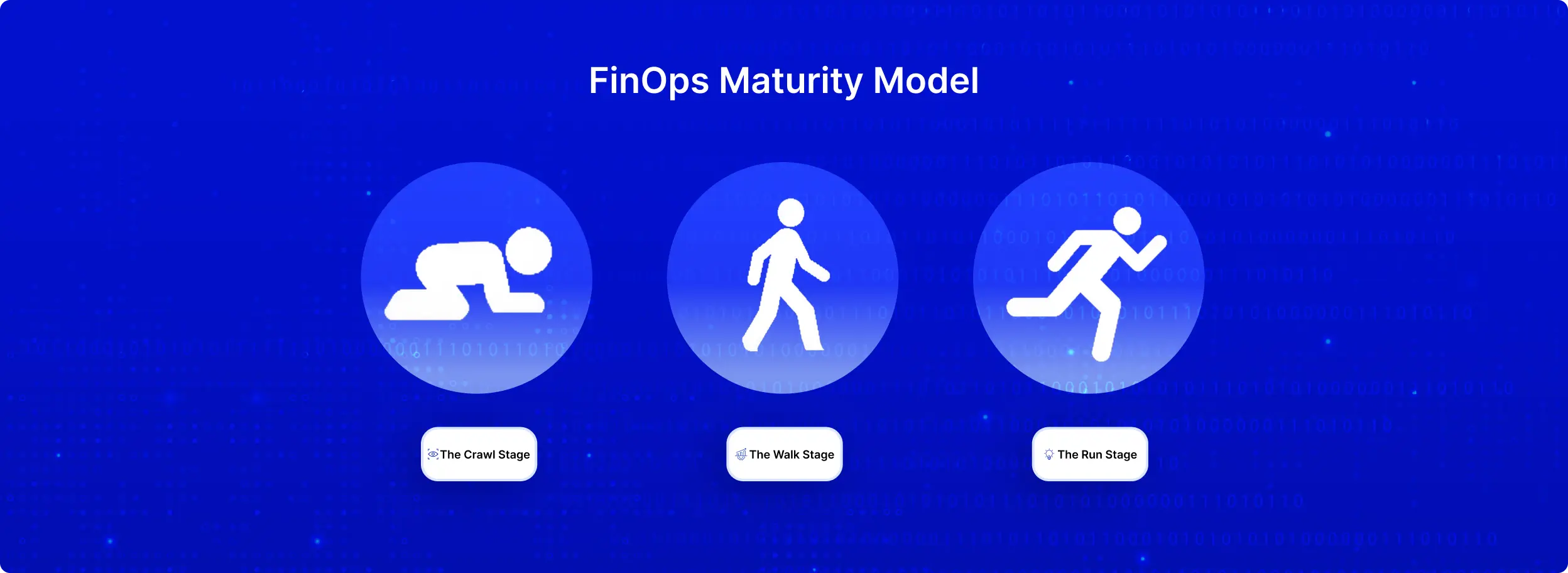
Instead of using five complex stages, the FinOps Foundation simplifies the path into three clear phases: Crawl, Walk, and Run.
This "Crawl, Walk, Run" progression gives teams a practical way to manage cloud unit economics. It acknowledges that you cannot automate complex cost savings until you understand your basic billing data.
To stop wasting money, you must understand your current position. The FinOps Foundation defines three specific stages. Each stage has defined characteristics, challenges, and key performance indicators (KPIs).
Characteristics & Challenges: Companies in the Crawl stage have a reactive posture. They pay the cloud bill when it arrives, but they do not understand what drives the costs.
There is basic awareness that cloud spending is a problem, but teams lack the automation to address it. Cost allocation requires high manual effort. Finance teams spend days sorting and trying to match cloud resources to specific departments.
Must-Track KPIs:
The Goal: The primary goal at this stage is basic visibility. You must understand your AWS, Azure, or GCP bills. You need to know which team or product uses which resources. You must also build a foundational culture where engineering and finance begin to communicate about costs.
Characteristics & Challenges: Companies in the Walk stage have a proactive posture. They understand their bills and actively implement chargeback or showback models.
A chargeback model bills internal departments for their specific cloud usage. A showback model simply shows departments what they spent without moving actual money.
Teams have standardized processes for tagging resources, but they struggle with complex automation.
Must-Track KPIs:
The Goal: The goal is to implement automated anomaly detection. You want the system to alert you immediately if spending spikes. You also need to begin basic rightsizing, which means matching server sizes to actual workload demands.
Finally, you must achieve cross-disciplinary alignment. DevOps, IT Asset Management (ITAM), and Finance teams must work together smoothly.
Characteristics & Challenges: The Run stage represents a highly optimized environment. Cost control is fully integrated into engineering workflows. Engineers can see cost estimates directly in their CI/CD pipelines before deploying code. The focus shifts from purely cutting costs to understanding Unit Economics.
Must-Track KPIs:
The Goal: The main goal is to align cloud spend with business value. You use fully optimized automation to shut down idle resources, scale capacity based on demand, and track the exact cloud cost required to serve one customer or process one transaction.
No. You only need to mature to the level that provides business value. Many organizations operate successfully in the Walk stage for years.
Moving to the Run stage requires significant investment in engineering time and the best FinOps tools that offer autonomous remediation rather than just passive charts. If your cloud spend is relatively small, the cost of reaching the Run stage might exceed the savings. You must evaluate your specific business needs.
You cannot improve what you do not measure. You need a clear, objective way to evaluate your current capabilities across cloud usage visibility, optimization, and organizational alignment.
Use this simple point-based checklist to assess your current stage. Score your organization on each point.
FinOps maturity directly affects daily operations across teams.
For Engineering Teams: Higher maturity means less friction. Engineers receive clearer architecture guidelines. When cost data integrates with their existing tools, they do not have to leave their workflow to check budgets. It prevents finance teams from asking engineers to cut costs randomly at the end of the quarter.
For IT Asset Management (ITAM) and Finance: Mature FinOps processes provide financial predictability. Finance teams can forecast budgets accurately. Automated chargebacks eliminate manual spreadsheet work. ITAM teams gain clear visibility into software licenses running on cloud instances, ensuring compliance and preventing duplicate purchases.
Moving from one stage to the next requires specific, actionable steps. You cannot buy maturity; you must build the processes.
Step 1: Standardize a core tagging set across all major cloud providers: Create a strict naming convention for tags. Require tags for "Owner," "Environment" (e.g., Production vs. Testing), and "Application." Use cloud provider policies (e.g., AWS Tag Policies) to prevent engineers from launching resources without the required tags.
Step 2: Establish a regular cadence for reviewing billing anomalies: Do not wait for the monthly invoice. Set up basic alerts using the native provider tools to notify the team when daily spending exceeds a specified threshold. Schedule a brief weekly meeting between engineering and finance to review any unusual spikes.
Step 3: Move from Dashboard to dedicated FinOps tools: Dashboard breaks as your cloud environment grows. You must adopt native cloud cost management tools or third-party platforms that automatically aggregate billing data and provide visual dashboards.
Step 1: Integrate FinOps metrics directly into engineering CI/CD pipelines: Engineers should see the financial impact of their code before it goes live. Tools like Infracost can show developers cost estimates directly in their pull requests. This shifts cost accountability to the earliest point in the development cycle.
Step 2: Automate rightsizing recommendations and lifecycle management: Stop relying on humans to manually change server sizes. Implement automation tools that analyze CPU and memory usage, then automatically downsize oversized virtual machines during maintenance windows. Implement Time-to-Live (TTL) policies that automatically delete temporary testing environments after 48 hours.
Step 3: Shift the conversation to Unit Economics: A rising bill is acceptable only if revenue rises faster. Calculate your Unit Economics. Measure the exact cloud cost per transaction, cost per active user, or cost per API call.
Many companies reach the Walk stage and stall. They fail to reach the Run stage due to predictable organizational failures. Here are some common pitfalls you should be aware of.
Pitfall 1: Over-Engineering Solutions: Companies try to automate complex processes before fixing their baseline data. You cannot automate rightsizing if your tagging system is chaotic. Trying to apply machine learning to cost forecasting will fail if 40% of your resources are owned by an unknown party. Fix the foundation first.
Pitfall 2: Lack of Executive Buy-In: If the CEO or CTO does not mandate cost control, engineers will prioritize speed over efficiency. Finance teams cannot force engineering teams to change architecture. You must secure top-down mandates that make cost efficiency a primary engineering metric alongside security and uptime.
Pitfall 3: Ignoring the Theory of Constraints: Organizational growth stalls when companies fail to identify the actual bottleneck in their workflow. If the bottleneck is a slow approval process for purchasing Reserved Instances, buying a new dashboard tool will not solve the problem. Identify and fix the specific constraint slowing down your cost optimization efforts.
Pitfall 4: Tooling Over-Reliance: Software does not fix culture. Many companies assume that purchasing an expensive FinOps platform instantly creates maturity. A tool will show you the waste, but it will not fix the underlying communication silos between finance and engineering.
Now you are aware of both the pain points and what are the things that you should be doing, but let's make it even easier. But how? That’s where Costimizer comes in.
Costimizer acts as your automated FinOps engineer. We bridge the gap between finance and engineering. Costimizer is an Agentic AI platform that does more than just show you dashboards. It actively locates waste, identifies untagged assets, and provides actionable, risk-free recommendations to rightsize your infrastructure.
You simply connect your AWS, Azure, or GCP accounts. Costimizer scans your environment and instantly applies FinOps best practices. It automatically enforces custom budget guardrails, sets up Time-to-Live policies for unused resources, and identifies cost anomalies in real time before they become billing disasters.
When you implement automated cost governance, you achieve predictable bills and immediate savings. You can confidently scale your business knowing your infrastructure is lean and highly optimized.
Start your journey to FinOps maturity. Try Costimizer for free today and instantly uncover hidden cloud waste.
It typically takes three to six months to make this jump. Success depends on establishing clear tagging rules and having engineers review their spending regularly. You move much faster when you replace manual spreadsheet tracking with automated reporting software.
This is a common business risk with passive reporting tools that only show dashboards. Costimizer offers a Zero-Risk Guarantee to eliminate this concern. If the platform does not identify more savings than the cost of your subscription, your first month is free.
You do not need a dedicated team to start saving money. A finance lead and a senior engineer can manage costs effectively if they share the exact same data. Using an automated platform acts as your virtual FinOps engineer, doing the heavy manual calculations for you.
Yes. Logging into three different provider systems makes accurate cost tracking nearly impossible for a finance team. Costimizer connects all your accounts into a single, real-time dashboard so you can instantly see your total cloud inventory and spending across every platform.
No, not if done correctly. Right-sizing means matching your server capacity to your actual traffic, not just buying the cheapest option available. A smart system measures your specific workload demands first to ensure your application performance remains perfectly stable.
Cloud provider alerts often take 24 hours to notify you, meaning your budget is already damaged. Costimizer detects abnormal spending patterns in under five minutes. It sends an immediate alert so you can fix the issue before it turns into a painful monthly invoice.
Yes. Engineers actually lose time when they have to pause product work to investigate unexpected billing spikes. When you build automated financial limits directly into their daily deployment tools, they can release code quickly while staying safely under budget.
No. Costimizer uses an Agentic AI system that actively resizes servers and shuts down idle resources for you. You can set it to ask for your approval first, or let it work automatically to save your engineers hundreds of hours of manual work.
•
CFO•
Articles