When you get your monthly Azure invoice and see that you’ve been charged thousands of dollars higher than expected. By the time you see the bill, the money is already gone out of hand. This happens to businesses very often because standard azure cost management budgets only notify you after the damage is done.
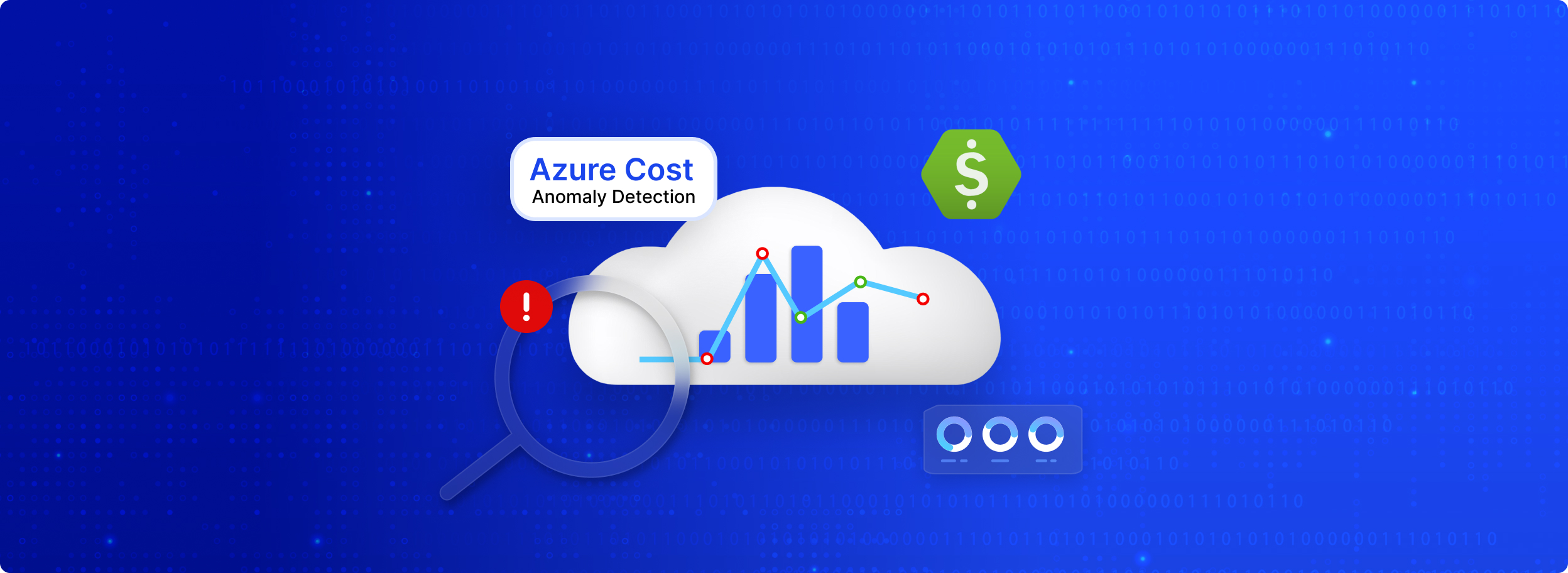
Azure cost anomaly detection changes this workflow entirely. Instead of waiting a month to review a bill, the system monitors your daily spending patterns and flags unusual activity as it happens. This allows you to find forgotten test servers, broken automation scripts, and accidental configurations before they compound into massive financial losses.
This blog clearly explains how cloud billing spikes happen, how to configure Azure’s native detection tools, and how to build an automated process to protect your profit margins.
Key Takeaways:
Azure cost anomaly detection is the process of identifying unexpected variations in cloud spending compared to your historical baselines.
Standard budget alerts notify you when your total spending crosses a specific dollar amount. Anomaly alerts notify you when your daily spending deviates from expected mathematical patterns. They do this regardless of your overall budget limits. If a database normally costs $50 a day and suddenly costs $300 a day, an anomaly alert triggers immediately.
Also Read: Azure Cosmos DB Pricing
Catching these spikes prevents severe budget leaks. It catches architectural mistakes early. It identifies rogue automation scripts. Most importantly, it shifts your financial management from a reactive state to a proactive state.
The algorithm looks at your last 60 days of spending history. It analyzes the normal peaks and valleys of your usage. For example, it learns that your costs naturally drop on weekends and rise again on Monday mornings. Based on this historical data, it calculates an expected band of spending for the current day.
If your actual daily spend lands outside this expected band, the system flags it as an anomaly.
While the native Azure tool is helpful, you must understand its structural limitations:
Cloud costs rarely spike because of actual user growth. They spike because of operational inefficiency and forgotten resources. Here are the most common ways businesses lose money in Azure:
Sudden Usage Spikes: Your applications might experience an unexpected burst of compute or storage demand. This often happens during unoptimized code deployments where an application gets stuck in an infinite loop, constantly writing data to a storage account or querying a database.
Unexpected Resource Creation: Engineers have the power to provision massive amounts of infrastructure instantly. Sometimes, an automated deployment script malfunctions and creates duplicate resources. Other times, a compromised account allows an external attacker to spin up expensive servers for cryptocurrency mining.
SKU and Tier Changes: Cloud providers offer different performance tiers. An engineer might manually scale a database to an expensive "Premium" tier to troubleshoot a slow query. If they forget to scale it back down to the "Standard" tier after the test, your daily cost multiplies instantly.
Forgotten and Idle Resources: When a virtual machine is deleted, the attached data disks and public IP addresses often remain active. These are called orphaned resources. You continue paying for them even though they serve no business purpose. Over time, these forgotten components accumulate and quietly inflate your baseline costs.
Unapplied Commitments: Businesses often purchase Azure Reserved Instances or Savings Plans to receive discounts in exchange for a one-to-three-year commitment. If an engineer changes the server type to a model that does not match your reservation, the discount drops off. You suddenly start paying the full, on-demand retail price without realizing it.
Data Egress Spikes: Moving data into the cloud is usually free. Moving data out of the cloud to the internet, or transferring data between different geographic regions, costs money. A sudden change in how your application routes data can generate massive data transfer fees overnight.
Also Read: Azure Blog Storage Pricing Guide
Now you must be aware of its type. Let's go deep into this with a real-life example, which is from a video on YouTube where the narrator, Mike Stevenson, a cloud architect, shared a common scenario that highlights this exact problem.
Here is what happened: An engineering team maintained a virtual machine specifically for product demonstrations. To save money, this machine ran on an automated schedule, shutting down every evening and restarting every morning. One afternoon, a developer manually removed the machine from the shutdown schedule to finish a late-day test. They forgot to turn the schedule back on. The machine ran continuously for weeks.
The Process Failure: The anomaly detection system actually worked. It generated an alert the very next day, showing a spike in compute costs. However, the alert went to an unmonitored email inbox. No one noticed the error until the finance team conducted its end-of-month review.
The Lesson: Alerts have no value without an escalation policy. Your anomaly detection tools must route notifications directly to the people responsible for fixing them, and those people must be held accountable for investigating the issue immediately.
Setting up basic anomaly detection in Azure requires no technical background. Business owners can mandate that their operations team follow these exact steps to ensure baseline protection.
Step 1: Access Cost Management: Log in to the Azure Portal. Search for and select "Cost Management + Billing" from the main navigation menu.
Step 2: Navigate to Alerts: Select your billing scope or subscription. In the left-hand menu under the "Cost Management" section, click on "Cost alerts."
Step 3: Add an Anomaly Alert: Click the "+ Add" button at the top of the screen. You will see an option to select the alert type. Choose "Anomaly" from the drop-down menu.
Step 4: Define the Scope and Recipients: Select the specific Azure Subscription you want the system to monitor. Next, enter the email addresses of the people who should receive the alerts. You must include both the engineering lead and the financial controller.
Step 5: Save and Monitor: Click Create. The system will now begin comparing your daily spend against the WaveNet algorithm's predictions.
Receiving an alert is only the first step. You must quickly identify who caused the spike and how to fix it. When an alert arrives, your team should execute this exact playbook.
Step 1: Locate the Visual Proof: Open the Azure Portal and navigate to the "Cost Analysis" tool. Switch to the "Smart Views" tab. This dashboard displays your daily spending as a bar chart. Look for the red "Anomaly diamonds" resting on top of specific days. These markers indicate exactly when the machine learning model detected the deviation.
Step 2: Isolate the Driver: You need to narrow down the data. Below the chart, use the grouping tools. First, group the costs by "Service Name" to see if the spike came from Virtual Machines, Storage, or SQL Databases. Next, group by "Resource Group" to pinpoint the exact project. Finally, group by "Meter" to see the specific billing mechanism, such as compute hours or data transfer.
Step 3: Identify the Actor: Once you know the exact resource that caused the spike, you need to find out who modified it. Open the "Azure Activity Log." This log records every single administrative action taken in your environment. Filter the log by the specific resource name and the date of the anomaly. The log will show you the exact user account or automated script that initiated the change.
Step 4: Analyze the Technical Context: Speak with the engineer identified in the Activity Log. Use tools like Azure Monitor and Azure Advisor to check the performance metrics of the resource. You need to determine if the spending spike was necessary. Did the application receive a massive influx of legitimate customer traffic? Or did a developer make a configuration error?
Step 5: Perform Root Cause Remediation: Document the findings. If the spike was a legitimate business event, you can mark the anomaly as "Expected" to help train the algorithm. If the spike was an error, the engineering team must immediately revert the configuration change, delete the rogue resource, and document the failure to prevent it from happening again.
Relying on email alerts guarantees failure. Inboxes are crowded, and engineers routinely ignore automated system emails. To protect your business, you must inject these alerts directly into your team's daily workflow.
Routing to ChatOps: Your engineers spend their day in Slack or Microsoft Teams. You can use Azure Logic Apps to intercept the anomaly email and convert it into a direct chat message.
Outcome: The alert appears instantly in a dedicated #cloud-finance Slack channel. The entire team sees the alert simultaneously, preventing anyone from claiming they missed the email.
Routing to ITSM Platforms: Enterprise environments require formal tracking. You can configure Azure Action Groups to automatically generate an incident ticket in Jira or ServiceNow the moment an anomaly is detected.
Outcome: The cost spike is treated as a severe operational incident. It is assigned to an engineer, tracked against a Service Level Agreement (SLA), and cannot be closed until a documented fix is applied.
Advanced Security Triage: Sometimes a cost spike is a security breach. Attackers steal credentials and deploy servers to mine cryptocurrency. You can integrate anomaly alerts with Microsoft Sentinel, Azure's security platform.
Outcome: Security teams see the billing spike alongside network traffic logs. They can immediately isolate the compromised resources and block the attacker's access.
If you operate across multiple cloud providers, you will notice that each vendor handles anomaly detection differently. CXOs must understand these differences to manage multi-cloud budgets effectively.
Amazon Web Services (AWS): AWS offers AWS Cost Anomaly Detection. Like Azure, it uses machine learning to establish a baseline. However, AWS provides more granular control out of the box. Users can adjust the alert thresholds based on specific dollar amounts or percentage deviations. AWS also provides direct API access to retrieve anomaly data, making it easier to integrate with custom reporting tools.
Google Cloud Platform (GCP): Google Cloud integrates AI detection by default across its billing dashboards. GCP allows users to set highly customizable thresholds and heavily promotes its integration with Google Workspace tools for alerting.
Microsoft Azure: Azure's native cost anomaly detection requires manual opt-in for subscriptions. Its primary limitation is the inability to fine-tune the sensitivity of the machine learning model directly within the Cost Management UI. Furthermore, extracting alert data programmatically requires setting up Scheduled Actions APIs or relying on Logic Apps to parse email payloads, which adds engineering overhead.
Native cloud tools are built to monitor a single environment. They struggle when your business grows complex. An engineer on Reddit noted this reality: "Manual checks, cost alerts at the RG/ sub/ MG, Azure Advisor, 3rd party tools. We also do biweekly reviews."
When native tools create too much manual work, businesses turn to third-party azure cost optimization tools and FinOps platforms. Here is when you need to upgrade:
Need for Unit Economics: Native tools tell you that your database costs increased by $1,000. They do not tell you if that increase is profitable. Third-party platforms tie cloud spending directly to business metrics. They calculate your cost-per-customer or cost-per-transaction. If your cloud bill goes up 10%, but your customer base goes up 20%, the anomaly is positive. Unit economics prevent false alarms and align engineering with business outcomes.
Multi-Cloud Aggregation: If you run workloads in Azure, AWS, and GCP, checking three different portals is inefficient. Third-party tools pull all billing data into a single pane of glass. This allows your finance team to enforce consistent Chargeback and Showback policies across the entire organization, regardless of which cloud vendor hosts the application.
Agentic Execution vs Passive Reporting: The biggest flaw with native tools is that they only report the problem. They do not fix it. This leaves the burden on your engineers to manually log in, investigate, and turn off the offending servers. Modern FinOps platforms solve this through active remediation.
Costimizer was built specifically for businesses tired of passive dashboards and delayed alerts. It shifts cloud management from a reporting exercise into an automated, self-healing process.
Instead of waiting 48 hours for Azure to process a billing file, Costimizer connects directly to your cloud environment to monitor resource activity in near real-time.
Agentic AI for Immediate Action: Costimizer uses Agentic AI. It identifies the idle resource, verifies that it is not serving production traffic, and can automatically park or shut down the instance based on rules you define. You retain complete control, but the software does the heavy lifting.
Cross-Cloud Visibility: Whether you are evaluating azure vs aws cost visibility or managing Google Cloud workloads, Costimizer normalizes the data.. It gives your finance team a unified view of your entire inventory. You can enforce strict budgets across multiple providers from one interface.
Guaranteed Savings: Manual optimization relies on engineers finding free time to clean up infrastructure. Costimizer operates continuously. By automating rightsizing, enforcing time-to-live policies for test environments, and catching anomalies instantly, the platform actively drives your cloud bill down. Many teams see a 20% to 30% reduction in cloud waste within the first month.
Try Costimizer today to connect your AWS, Azure, and GCP accounts. Let our Agentic AI detect anomalies instantly, shut down idle resources, and automatically reduce your cloud bill.
Yes, Microsoft includes native anomaly detection at no additional charge within your subscription. However, relying solely on it carries hidden financial risk due to the 36-to-72-hour data processing delay before an alert actually triggers.
We operate on a zero-risk guarantee. If our platform does not identify more cloud savings than the cost of your subscription, your first month is completely on us.
No, native budget and anomaly tools only send notifications via email or configured webhooks. Stopping the actual infrastructure requires your team to build custom scripts using Azure Automation or to deploy an active FinOps platform.
No software installation is required. Costimizer connects securely via a read-only API integration that takes exactly 60 seconds to configure, immediately providing a single pane of glass for your Azure, AWS, and GCP spending.
False positives occur when expected business growth triggers mathematical alerts. You reduce them by implementing unit economics, measuring cost per transaction, and upgrading to tools that allow you to adjust the algorithm's sensitivity.
Never. You maintain absolute control over the Agentic AI by setting strict guardrails and policies. You can require manual approval for production changes while allowing automatic parking for isolated development or staging environments.
While Azure natively defaults to monitoring at the subscription level, you can achieve team-level tracking by implementing a comprehensive azure tagging strategy. You can then use these tags to filter data and route specific billing spikes directly to the responsible developers.
Native tools process billing data with a multi-day delay, notifying you only after the budget is wasted. Costimizer monitors your live usage in near real-time, catching expensive misconfigurations in minutes rather than days.
•
CFO•
Articles