49% of organizations see their cloud expenses increase immediately after adopting Kubernetes. Despite this predictable expense spike, only 14% of companies maintain active chargeback programs to track where that money goes.
The problem is clear. Kubernetes hides the underlying servers, making it impossible to assign costs to specific teams using standard cloud provider billing reports.
Cost optimization is a behavioral challenge. To gain control of your budget, you must change how your engineering teams view their resource consumption.
This blog explains the exact difference between Kubernetes showback and chargeback. It provides a step-by-step implementation plan to assign shared costs accurately.
60-Second Summary:
To understand why Kubernetes billing is difficult, you must examine how traditional cloud billing works. In a traditional setup, you rent a single virtual server for a specific application. At the end of the month, your cloud provider sends a bill showing the exact cost of that single server. You know exactly which department is responsible for the expense.
Kubernetes changes this structure entirely.
Kubernetes pools many servers together into a single ‘cluster.’ Multiple departments deploy their applications onto this shared group of servers. This creates a multi-tenant environment.
When your finance team receives the monthly Amazon Web Services (AWS) or Google Cloud Platform (GCP) bill, they see a massive charge for the total group of servers. The bill does not show which department used which percentage of the computing power.
Because the infrastructure is shared, individual teams don’t feel responsible for the total cost. If an engineer provisions too much memory for their specific application, they do not see the financial impact.
This leads to severe over-provisioning. Industry data shows the average Kubernetes cluster operates at just 20% to 35% utilization. You are paying full price for servers that sit mostly idle.
Also Read: Kubernetes Cost Optimization Guide
Tracking individual applications (called "pods" in Kubernetes) is technically difficult because they are ephemeral. A pod might start up to handle a sudden spike in website traffic, run for exactly four minutes, and then shut down.
Standard cloud billing reports operate on hourly or per-second billing for the underlying server, not the four-minute lifespan of the pod inside it.
As one of our shared with us:
‘We have several clusters. And it's hard to understand precisely what namespace, deployment, job, or standalone pod costs what in the cluster. Also, how do you keep track of nodes being idle?’
Furthermore, Kubernetes requires shared management software to function. Features like the control plane (which manages the cluster), network routing tools, and security monitors run continuously.
These shared components consume CPU and memory. Dividing the cost of these shared services fairly among different business units requires complex mathematical models.
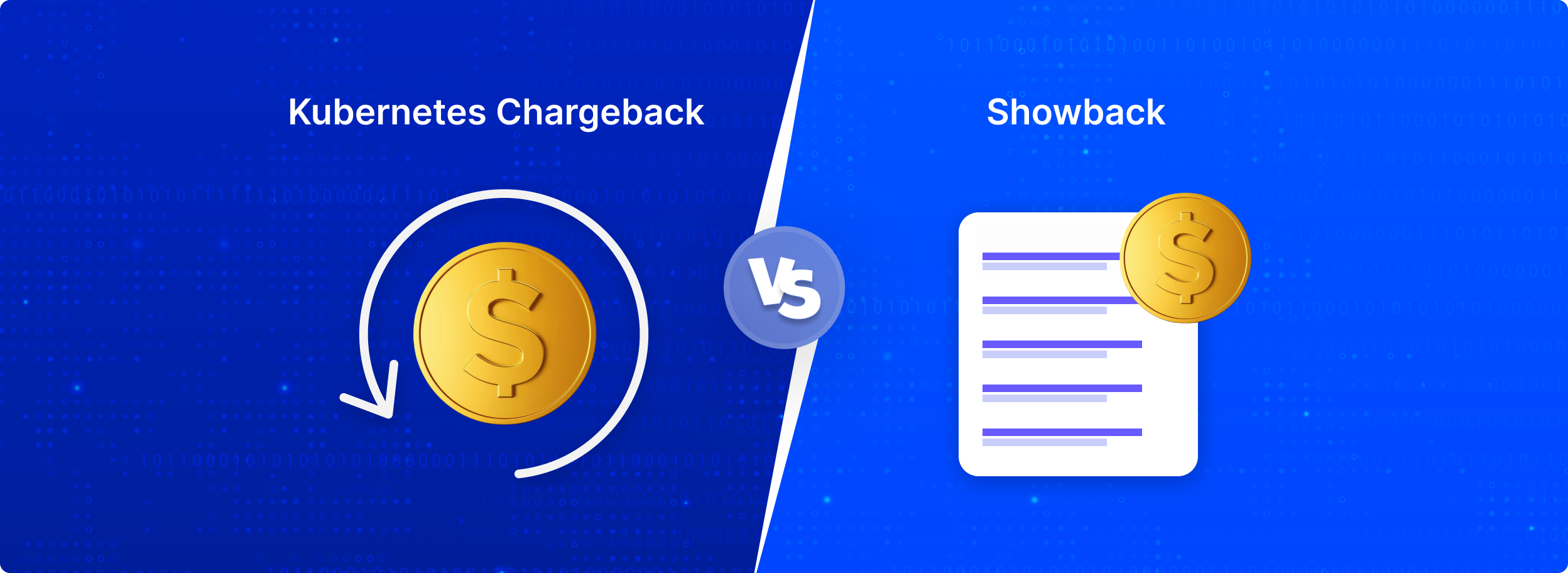
Kubernetes showback is a financial reporting method. It calculates the exact cost of the computing resources used by a specific team and presents the results in a report.
In a showback model, no actual money changes hands internally. The central IT or Finance department continues to pay the entire cloud bill. The report acts as a "shadow bill" to educate the engineering teams about their consumption habits.
The core concept of showback is simple: Showback moves information.
The Goal: The primary objective is to build cost awareness. By showing a department that they spent $45,000 on development environments last month, you encourage them to identify waste.
Showback enables teams to verify the accuracy of the cost-tracking system without the stress of actual financial penalties.
Kubernetes chargeback is a strict financial enforcement model. It transfers the actual cost of cloud resources directly to the specific department that consumed them.
In a chargeback model, the costs are formally deducted from a department's Profit and Loss (P&L) statement. If the marketing team's applications consume $20,000 of Kubernetes resources, the marketing department's operational budget is reduced by $20,000.
The core concept of chargeback is highly direct: Chargeback moves money.
The Goal: The objective is to drive strict financial accountability. When a department manager sees cloud expenses directly impacting their available budget, they immediately prioritize efficiency. Chargeback forces teams to right-size their applications and turn off unused testing environments.
Choosing between these two models determines how your company handles IT finance. Here is a direct comparison of how each model impacts your business.
Feature | Kubernetes Showback | Kubernetes Chargeback |
Primary Goal | Education and awareness | Financial accountability and efficiency |
Financial Impact | Informational only. Central IT pays the bill. | Hits the department P&L directly. |
Implementation Complexity | Moderate. Requires data collection and reporting dashboards. | High. Requires integration with corporate accounting software. |
Behavioral Change | Encourages teams to look for obvious waste. | Drives active, mandatory optimization efforts. |
Accuracy Requirement | High accuracy is preferred, but minor tracking errors are tolerated. | Perfect accuracy is mandatory to avoid internal disputes. |
If you are looking for a direct recommendation, you must start with showback. Attempting to skip the reporting phase will severely disrupt your engineering operations.
Many business leaders want to implement chargeback immediately to stop budget overruns. This is a common and expensive error known as the "Resentment Trap."
If you charge an engineering manager $100,000 for their monthly cluster usage, they will immediately ask for proof. If your kubernetes tagging strategy has missing tags or relies on estimated averages, the manager will reject the bill. They will view the chargeback program as an unfair tax.
Our FinOps Expert Vinmara summarizes this perfectly:
"When cost visibility precedes cost integrity, awareness compounds; when accountability precedes attribution clarity, resistance compounds."
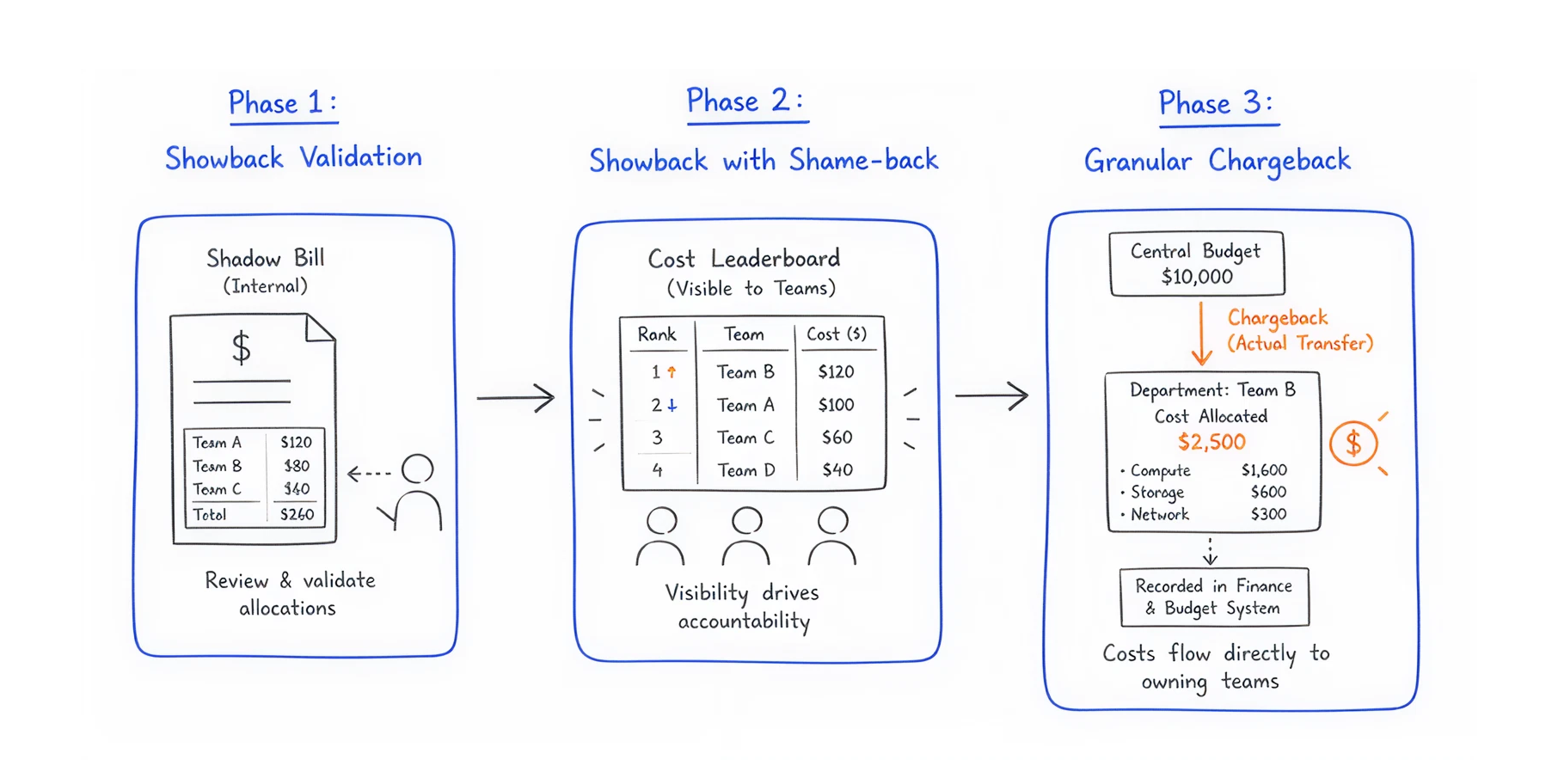
To avoid this trap, you should follow a 3-phase hybrid implementation strategy.
Run a showback program for three consecutive months. Distribute the shadow bills to department heads. Ask them to review the data for inaccuracies. This period allows your IT team to fix broken tracking tags and refine their cost allocation formulas.
Once the data is accurate, introduce an internal marketplace or leaderboard. Rank your engineering teams based on their cost efficiency. Peer pressure is a highly effective tool. No engineering team wants to be publicly ranked as the most wasteful department in the company.
After teams trust the data and understand their usage patterns, activate a formal chargeback. Link the Kubernetes cost data to your accounting software. Teams will now take direct ownership of their cloud budgets.
Implementing chargeback requires specific technical steps. You cannot simply divide the total bill by the number of teams. You must track consumption accurately at the application level.
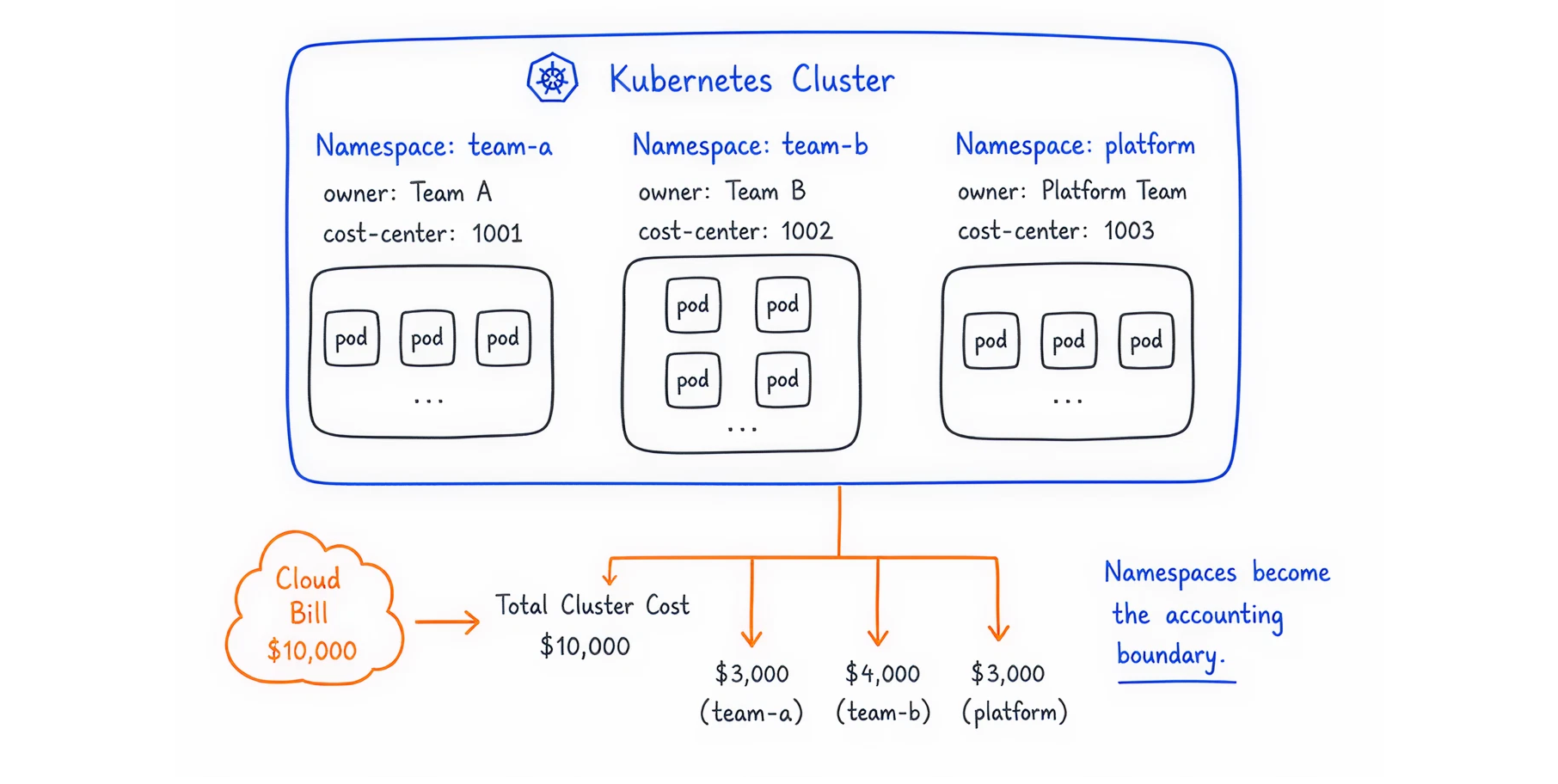
A Kubernetes namespace is a virtual boundary inside your cluster. You should assign one namespace to each specific team or project.
Namespaces are the most reliable boundary for cost tracking. You can apply tracking labels directly to the namespace. When you label a namespace with cost-center: marketing, every application running inside that boundary is automatically linked to the marketing budget. This eliminates the need to manually tag hundreds of individual pods.
Learn more about Kubernetes namespace.
If your team struggles with manual tagging, you will lose money. Costimizer offers an automated Cloud Tag Management feature that identifies untagged resources and automatically applies virtual tags.
This ensures accurate kubernetes cost allocation across departments without manual engineering effort.
Your cluster runs shared software that benefits everyone. This includes the Kubernetes control plane, security agents, and monitoring tools like Prometheus.
You must decide how to split the bill for these shared tools. The standard industry practice is proportional allocation.
You calculate the total cost of the shared services. You then divide that cost based on how much compute power (CPU) each team uses.
If the database team uses 40% of the cluster's total CPU, they pay for 40% of the shared monitoring costs. Document this mathematical formula clearly so all departments understand the charges.
If you rent a server for $100, but your applications only use $60 worth of processing power, you have $40 of idle capacity. You must decide who pays for the $40 of waste.
You have two options.
The first option is distributing the idle cost evenly among all tenants. This is unfair to highly efficient teams.
The second option is assigning the idle cost to the central IT infrastructure budget. When central IT bears the cost of idle capacity, they are highly motivated to right-size the underlying servers and eliminate waste.
When billing a team for an application, you must look at two metrics: the resources they requested and the resources they actually used.
Kubernetes allows engineers to reserve capacity in advance. If an engineer reserves 10 units of memory but only uses 2 units, those 8 unused units are locked. No other team can use them.
To solve this, the FinOps Foundation recommends a weighted billing formula. You bill the team 70% based on the capacity they requested, and 30% based on their actual usage.
This formula penalizes teams for hoarding capacity they do not need. It forces engineers to reserve only the exact resources required to run their software.
You cannot manually calculate the Kubernetes chargeback. The environment changes too quickly. Pods spin up and shut down thousands of times per week.
Cloud provider tools like AWS Cost Explorer are insufficient for this task. They only see the underlying server (the Node). They cannot see the individual applications (the Pods) running inside the server. You need specialized software.
Several platforms exist to solve this specific billing challenge. You must choose a tool that complies with the FinOps Open Cost & Usage Specification (FOCUS) to ensure your data is standardized.
OpenCost: This is a free, open-source project governed by the Cloud Native Computing Foundation (CNCF). It provides accurate cost allocation and integrates directly with your cluster. It is highly effective for basic visibility but requires your engineers to maintain the reporting infrastructure.
Kubecost: This is a commercial platform built on top of OpenCost. It offers detailed reporting, long-term data storage, and customized pricing alerts. It is heavily utilized by enterprises that need out-of-the-box dashboards for their finance teams.
CloudZero and Amnic: These platforms ingest cost data from multiple sources. They combine your Kubernetes usage with your broader cloud spend (like external database costs) to give you a complete picture of your unit economics.
Costimizer (Agentic AI Execution): If you want a system that fixes the problem automatically. Costimizer is a platform built for the execution phase of cloud cost management.
Instead of just showing you a chart of idle resources, Costimizer actively automates Kubernetes pod rightsizing across your workloads.. It auto-parks non-production environments overnight and enforces budget guardrails.
It connects your cloud accounts in minutes and begins safely adjusting your infrastructure to match exact demand. You get the strict cost allocation required for chargeback, plus the automated action required to keep those costs low.

When businesses rush their FinOps initiatives, they make structural errors that invalidate their financial data. Avoid these three common mistakes.
Many companies view chargeback simply as the next software version of showback. This is wrong. Chargeback is a strict cultural shift. It requires changing how departments are funded and how managers are evaluated. If you implement a chargeback without adjusting departmental budgets to cover the new line items, operations will halt.
Organizations often focus entirely on CPU and memory usage. They ignore data transfer fees and Persistent Volumes (PVs). If an application moves massive amounts of data across different availability zones, it generates high network egress fees.
Your tracking tool must allocate these network and storage costs directly to the specific namespace responsible for the traffic.
Central IT often purchases bulk discounts, such as AWS Savings Plans, which function as capital expenditures (CapEx).
Engineering teams consume resources dynamically as operational expenditures (OpEx). If your chargeback model bills departments at the expensive "on-demand" rate while central IT pockets the bulk discount savings, the internal billing will be wildly inaccurate.
You must amortize the discount and pass the exact discounted rate down to the consuming department.
Implementing Kubernetes chargeback successfully connects resource utilization directly to business value. It is a system designed to treat financial efficiency with the same importance as application performance and system reliability.
By establishing clear namespaces, communicating shared costs, and applying the 70/30 usage formula, you empower your engineering teams to manage their own efficiency.
Stop relying on delayed billing reports. Your engineers should focus on building products, not auditing cloud infrastructure. Costimizer provides an automated Cloud Analytics Platform that tracks your Kubernetes spend in real time, enforces budgets, and uses Agentic AI to automatically eliminate waste.
Connect your cloud accounts in 60 seconds and instantly uncover your exact cost-saving opportunities.
Managing costs across different cloud providers is difficult because their billing structures do not match. You need a unified platform that standardizes data from all providers into a single view. This allows you to apply the exact same billing rules regardless of where the server operates.
Yes. Standard tools only provide reports, but Costimizer operates as an active agent. It can automatically resize your applications and shut down idle test servers based on the exact budget rules you define.
Billing disputes occur when teams question data accuracy. You must first establish a clear dispute process and demonstrate that your tracking methods are accurate during a showback phase. When the data is entirely transparent, engineers accept the charges.
We provide a zero-risk guarantee for our service. If the platform identifies more cloud savings than your subscription costs, your first month is free. We focus strictly on lowering your bill, not just tracking it.
Standard cloud bills separate your database costs from your Kubernetes expenses. You must use a tool that merges these external database charges with your internal cluster data. This calculation shows the true total cost of running that specific application.
Missing tags cause major billing errors in standard tools. Costimizer solves this using Virtual Tag Governance, which automatically finds untagged resources and applies the correct ownership labels. You achieve full cost allocation without forcing engineers to manually fix thousands of tags.
Manual chargebacks waste valuable employee hours. If you rely on manual data entry, the administrative cost will eventually exceed your savings. You avoid this problem by automating the entire billing calculation.
You connect your cloud accounts to Costimizer in under 60 seconds through a secure setup. The platform processes your billing data immediately and delivers accurate cost breakdowns and executable savings within 48 hours.
•
CFO•
Articles