


A few years ago, Figma revealed it was spending around $300,000 a day on Amazon Web Services. And it came as a reminder of how quickly cloud costs can scale when you’re not tracking them properly.
You run a software business to generate profit. But unpredictable server bills are eating your margins. When you don’t know your cloud cost per customer, you can’t price correctly, you can’t measure true margins, and growth.
This blog shows you exactly how to fix that, by breaking down direct costs, allocating shared infrastructure, and giving you a system that actually works.
60-Second Summary:
Cloud cost per customer is a specific financial metric. It measures the exact amount of money you spend on cloud computing to support one single user on your software platform.
To understand this, you must separate your Cost of Goods Sold (COGS) from your Operating Expenses (OpEx).
Your Cost of Goods Sold includes servers, digital storage, and data-transfer tools that directly deliver your product to the paying customer. If a customer logs into your app and saves a file, the database processing of that action is a COGS expense.
Your Operating Expenses include internal resources. This covers the testing environments your developers use to build new features. It includes internal employee software. It covers staging servers that never interact with a paying customer.
Knowing this difference matters for your unit economics. Unit economics measure the direct revenues and costs associated with a single business model unit. You need to know if a specific client is profitable.
Let's say a client pays you $100 a month for a subscription, but consumes $120 in server resources; you are losing money on that account.
Tracking your cloud costs per customer lets you identify which user segments drive actual profit. It informs your Customer Acquisition Cost limits. It helps you negotiate profitable contract renewals.
CXOs frequently ask if their cloud bills are normal. The industry rule of thumb is that a healthy software business should keep its production infrastructure costs between 5% and 10% of its total revenue.
If your business generates $10 million in annual recurring revenue, your production cloud bill should ideally sit below $1 million.
However, your target changes depending on your company's maturity.
Early-stage startups face realities different from those of mature enterprises.
Our CFO, Chandra, has a different take on startup infrastructure, with his decades of practical expertise.
He advises early startups to avoid complex multi-region setups on major providers. Instead, he recommends renting a simple $4 managed server on platforms like DigitalOcean. Simple, flat-rate pricing allows founders to focus entirely on acquiring customers rather than managing complex server networks.
As companies reach the growth stage, bills quickly escalate to tens of thousands of dollars per month.
At this point, companies adopt multi-cloud strategies. They spread workloads across Amazon Web Services, Microsoft Azure, and Google Cloud Platform. They implement strict financial operations controls.
The 2026 artificial intelligence trend is altering these benchmarks entirely. Integrating Agentic AI and large language models requires specialized hardware. Companies must rent GPUs or custom silicon like AWS Trainium. These machines are expensive. They often run continuously to process data.
This hardware requirement is driving average cloud bills significantly higher across the software sector.
Cloud providers allow you to attach digital labels, called tags, to your servers. You might tag a server with "Marketing Department" or "Client A." This works perfectly when a single client uses a dedicated server.
But modern software does not work that way. Modern software uses shared infrastructure.
You likely use a shared database to hold information for hundreds of different clients.
You use load balancers to distribute internet traffic evenly across your systems.
You use Kubernetes clusters to run shared applications efficiently.
Simple resource tagging fails completely here. You cannot attach a single customer's name to a database that serves five hundred companies simultaneously.
This creates a massive pain point for engineering and finance departments. Finance teams download massive billing sheets at the end of the month.
They attempt to divide these shared costs manually based on rough estimates. This process is slow. It produces highly inaccurate data. It causes friction between departments.
You need a systematic approach to measure these shared costs. Effective cloud cost management helps organizations move beyond estimations and accurately track cloud cost per customer.
Cost per Customer = Total Cloud Infrastructure Cost ÷ Total Number of Active Customers
First, you must separate your production costs from your development costs. You achieve this by organizing your cloud accounts strictly by environment.
Keep your development servers in one billing account.
Keep your production servers in a separate billing account.
This instantly filters out internal operating expenses. It isolates the cloud resources directly tied to serving your paying customers.
Billing data from your cloud provider only shows you the total money spent. It does not show you who caused the spending. You must combine your billing data with application telemetry.
Telemetry is raw data that shows exactly how your application is being used.
You need to track how many software requests a specific user makes. You need to measure how much digital storage they consume.
You need to record how many seconds your database is kept busy.
This usage data is the missing link required to calculate accurate customer costs.
The FinOps Foundation recommends a structured approach to dividing shared costs. Do not try to build a perfect system on day one.
The Crawl Phase (Even Split): Take your total shared infrastructure bill. Divide it evenly among all active tenants. If your shared database costs $10,000 and you have 100 customers, you assign a $100 cost to each customer.
This is easy to implement. However, it is inaccurate to say that one massive enterprise customer consumes 80% of your system's resources.
The Walk Phase (Fixed Proportional): Allocate the costs based on static business metrics. You might divide the bill based on the number of user seats a customer purchases. A customer with 50 employee seats pays a larger share of the infrastructure bill than a customer with 5 seats.
This improves accuracy but still ignores actual software usage.
The Run Phase (Variable Proportional): This is the enterprise standard. You use active product telemetry. You dynamically charge back costs based on exactly how much of the shared resources a specific customer consumed that day.
If Customer A generated 40% of the database queries this month, they are assigned 40% of the shared database cost.
You cannot manage what you do not measure. Software executives must track these four metrics to support effective cloud cost management and ensure their cloud spending remains profitable.
Cloud Efficiency Ratio (CER): CER = Total Cloud Spend ÷ Total Revenue Cost per Customer This metric calculates your total cloud spend divided by your total revenue. Keeping this ratio between 15% and 20% shows that your engineering team is building efficient software. A rising CER indicates your infrastructure costs are growing faster than your sales.
Resource Utilization Rate: Resource Utilization Rate = Average Resource Consumption ÷ Total Provisioned Capacity This measures how much of your rented server capacity is actually doing work. If your company rents a massive server that sits idle 80% of the time, you are over-provisioning. You are paying for unused capacity. High utilization rates mean you are getting maximum value from your cloud purchases.
Idle Resource Cost: Idle Resource Cost = Cost of Resources × (1 - Utilization Rate) This metric assigns a specific dollar value to your unused capacity. Engineers often ignore percentage-based utilization metrics. However, showing a team a $5,000 monthly charge labeled "idle servers" motivates immediate action.
Gross Margin by Customer Segment: Combine your revenue data with your accurate cost per customer data. You must analyze this by segment. You might discover that your small business clients generate an 80% profit margin. You might simultaneously find that your largest enterprise clients generate a 20% margin because they consume massive amounts of data storage. This data dictates where you should focus your marketing budget.
Cloud providers design their billing structures to capture maximum revenue. If you do not actively monitor your usage, you will fall into several expensive traps.
Availability Zone Data Transfer Fees: Cloud providers divide their data centers into separate physical buildings called Availability Zones. They charge you money when your data moves between these buildings. If your software uses chatty microservices that constantly send data back and forth across different zones, you will rack up massive network charges.
Zombie Assets: These are forgotten digital resources. A developer might delete a virtual server but forget to delete the storage drive attached to it. These unattached volumes, forgotten backup snapshots, and idle load balancers drain your budget every single hour. Enterprises waste an average of 32% of their cloud spend on resources that deliver zero value.
Over-Provisioned Hardware: Modern hardware is heavily premium-priced. Leaving a specialized graphics processing unit running 24 hours a day when your team only needs it for a two-hour task is a severe financial error. You must implement automated schedules to turn these expensive machines off during the night and on weekends.
Default Storage Tiers: Companies routinely leave infrequently accessed customer data in standard, high-cost storage buckets. Amazon Web Services offers cheaper storage tiers for old data. As a general rule, if you access a file less than once a month, moving it to an infrequent access tier can save you 45% on storage costs.
To calculate per-customer costs and find these hidden traps, you must decide how to build your tracking system.
The DIY route involves using native cloud provider tools mixed with internal coding.
If your team writes custom scripts. They pull data from AWS Cost Explorer or Azure Cost Management into business intelligence dashboards.
This requires heavy engineering maintenance. Every time a cloud provider changes their billing format, your scripts break. Your developers spend valuable time maintaining billing dashboards rather than building features for your paying customers.
The alternative is using purpose-built platforms. You can research competitors' cloud cost-per-customer tools, such as CloudZero or Finout. These platforms connect your application telemetry to your billing data. They provide excellent visibility into your unit economics.
However, visibility is only the first step. Knowing that you are wasting money does not actually stop the waste. You need a system that actively manages the problem.
Knowing your cloud cost per customer is mandatory for modern software businesses. It serves as the foundation for scalable pricing models and profitable product development.
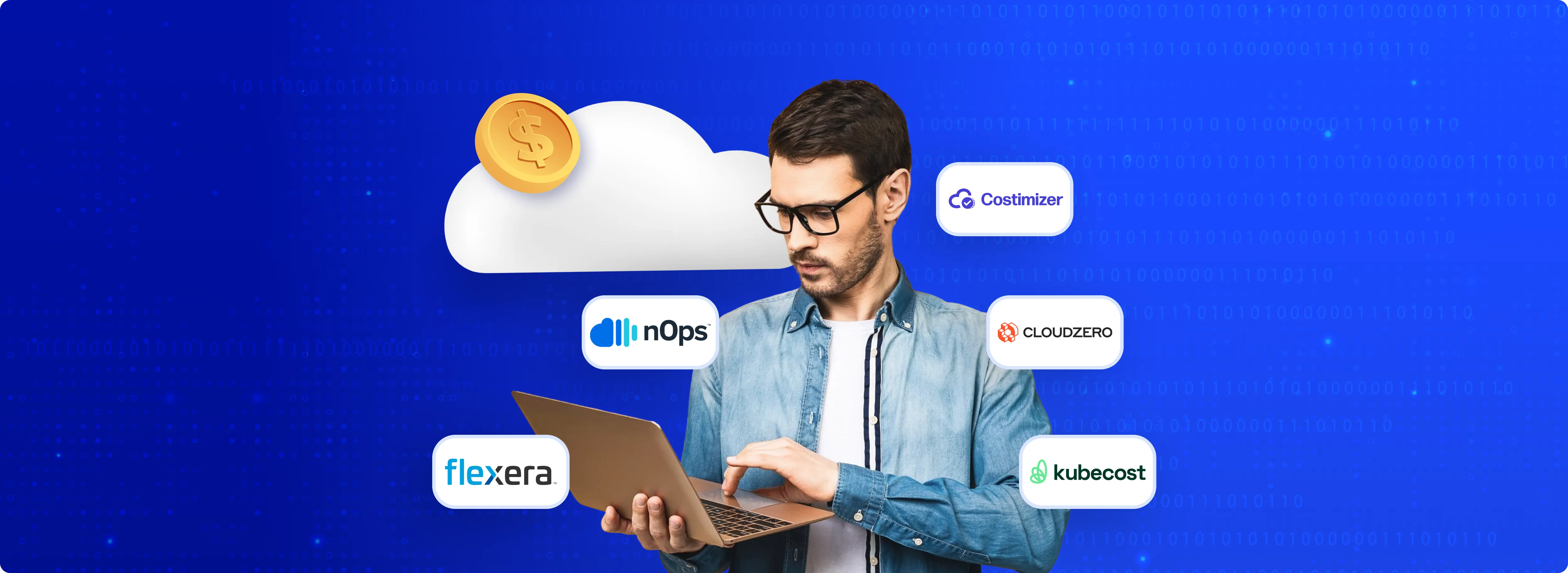
But you need to take the next step to lower your costs even further: an agentic tool like Costimizer acts as your automated financial operations guide
For example, Costimizer uses Agentic AI to automate your savings. It does not just show you a chart of idle servers. It actively shuts down those idle servers when they are not in use. It uses Pool Resourcing to logically group your costs, ensuring total accountability across your entire organization.
It works across AWS, Google Cloud, and Azure, giving you a single, unified view of your business.
You should track this metric continuously using automated software. If you rely on manual calculations, you should calculate them monthly alongside your standard financial close process. Daily tracking lets you catch costly engineering errors before they affect your monthly invoice.
Yes. Costimizer includes an automated Cloud Tag Governance feature. It uses AI to track your resource metadata, identify incorrectly tagged or untagged assets, and let you apply bulk tags to instantly fix your infrastructure organization.
Costimizer uses Pool Resourcing to logically group your shared infrastructure costs. It then ingests your application telemetry to dynamically charge back costs to specific business units or customer segments without requiring manual spreadsheet formulas.
Most teams identify hidden cloud waste within 60 seconds of connecting their cloud accounts. Because Costimizer actively terminates zombie assets and rightsizes instances, users typically see a reduction in their cloud bill within the first 48 hours of implementation.
Native tools show you what resources cost, but they cannot show you which customer used those resources. To get a per-customer breakdown, you must combine native billing exports with your own application telemetry data.
You remain in complete control. Costimizer's Agentic AI can operate in a "recommend only" mode where your team approves every action. Once you validate its accuracy, you can grant it permission to safely automate low-risk tasks, such as shutting down idle development servers at night.
You must track free-tier users exactly the same way you track paying customers. Their infrastructure consumption should be categorized as a marketing expense or Customer Acquisition Cost (CAC), rather than standard Cost of Goods Sold.
Basic cost tracking tells you your company spent $50,000 on servers this month. Unit economics tells you that you spent exactly $5 to host Customer A, allowing you to determine if Customer A's $20 subscription fee yields a sustainable profit margin.
Cloud cost per customer increases due to overprovisioned resources, idle infrastructure, inefficient workloads, high data transfer charges, and inaccurate cost allocation. Rapid growth in customer usage without optimizing cloud resources can also increase per-customer costs and reduce profit margins.
You can reduce cloud cost per customer by accurately allocating shared costs, rightsizing overprovisioned resources, and eliminating idle infrastructure. Regularly tracking per-customer cloud spending also helps identify unprofitable customers and optimization opportunities.
•
CTO•
Articles